
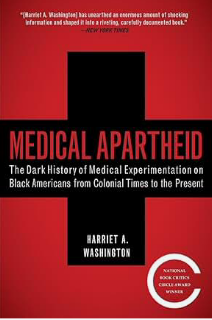

Harriet A. Washington’s “Medical Apartheid” is a groundbreaking and deeply unsettling exploration of the dark history of medical experimentation on African Americans. Published in 2007, this National Book Critics Circle Award-winning work meticulously documents centuries of unethical medical practices, from slavery to the present day.
Washington, a prolific science writer and medical ethicist, brings both academic rigor and compelling storytelling to this crucial topic. Her background in medical journalism and ethics shines through as she uncovers disturbing accounts of exploitation, from James Marion Sims’ gynecological experiments on enslaved women to the infamous Tuskegee syphilis study.
As a reader, I was profoundly moved by Washington’s ability to humanize the victims of these experiments while exposing the systemic racism that allowed such practices to continue for so long. Her exploration of how racist pseudoscience and social Darwinism were used to justify unethical treatment is particularly enlightening and disturbing.
“Medical Apartheid” is essential reading for anyone seeking to understand the roots of healthcare disparities and mistrust of the medical establishment in the Black community. Washington’s work goes beyond well-known cases to reveal lesser-known but equally shocking experiments, providing crucial context for contemporary discussions about race and medicine.
The book’s relevance has only grown since its publication. In our current era of heightened awareness about systemic racism, “Medical Apartheid” offers invaluable insights into how deeply entrenched these issues are in American healthcare. It challenges readers to confront uncomfortable truths and consider how this history continues to shape medical practices today.
Questions to ponder:
1. How has the history detailed in “Medical Apartheid” influenced current healthcare disparities?
2. In what ways can understanding this history help address ongoing issues of medical mistrust in Black communities?
3. How might the ethical principles developed in response to past abuses be applied to emerging medical technologies and research?



0 Comments